
Mild Winter + Extreme Heat: Protect Your Phoenix Landscape
In the Phoenix metro area, trees and landscape plants survive by timing everything perfectly.
They rest in the winter. They grow in the spring. They brace for stress in the summer.
But what happens when that natural rhythm gets disrupted by unusual weather patterns?
That’s exactly what we’re seeing across the Valley right now and it’s putting
landscapes at serious risk.
Why Phoenix’s Mild Winter is a problem for trees
A typical winter in the Phoenix area gives plants a critical chance to slow down. Growth pauses,
energy is stored in roots, and pests and diseases are naturally suppressed by cooler
temperatures. But when winter stays warm, as it did this year across much of Arizona, we miss something critical for landscapes:
Dormancy never fully kicks in.
Without a true dormancy period, trees continue low-level metabolic activity all winter. Stored
energy reserves don’t fully replenish. Pest cycles that normally get interrupted by cold
temperatures continue unchecked.
Think of it this way…Instead of getting deep, restorative sleep, your trees just took a bunch of short naps. The enter Spring already fatigued”
– Ryan Kibner, Adaptive Plant Health Solutions
Early heat Spikes compound the stress
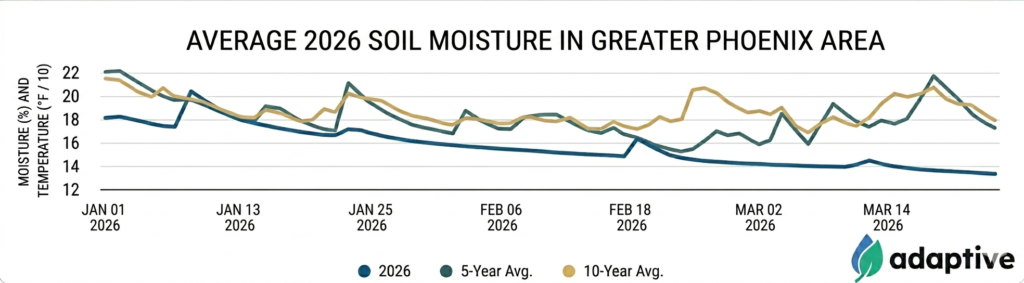
Now layer record-breaking temperatures on top of that mild winter. Heat is arriving earlier than
normal, and soil temperatures are staying elevated around the clock.
This is where the damage compounds. Plants that would normally have a full tank of energy
reserves are now entering extreme Phoenix summer heat conditions already depleted.
Weakened plants + early extreme heat = accelerated decline.
High soil temperature: The hidden threat to your root zone
Most Phoenix homeowners pay attention to air temperature. But your trees and landscape
plants care just as much, if not more, about soil temperature in the root zone.
When soil temps climb, the consequences are significant:
- Root function declines, reducing the plant’s ability to absorb water and nutrients
- Microbial life in the soil (the biological engine that drives plant health) becomes less
efficient - Water uptake becomes inconsistent, even with adequate irrigation
- Oxygen availability in the soil drops sharply
In Phoenix landscapes with decorative rock, artificial turf, or compacted desert soil, these effects are amplified dramatically.
Soil temperatures near rock mulch, artificial turf, and south- or west-facing exposures can run 20+ degrees higher than surrounding areas. That radiant heat goes directly into the root zone where your trees are trying to survive.
Signs of heat stress in Phoenix trees and landscapes
When a mild winter, early extreme heat, and elevated soil temperatures combine, the result is a
perfect storm of landscape stress. Here’s what we’re already seeing across properties in the
Phoenix metro:
increased tree stress
Trees are working harder and earlier in the season with fewer stored energy reserves to draw
from. Leaf scorch, wilting, and premature leaf drop are early warning signs.
Higher water demand with lower efficiency
Plants need more water under heat stress, but compromised root systems are less capable of
using it effectively. You may see decline even in well-irrigated landscapes.
More pest and disease pressure
Borers, aphids, spider mites, and other destructive pests thrive when trees are stressed. A
weakened tree is an open invitation for secondary pest and disease problems.
Greater risk of rapid decline or total loss
Landscape decline that used to play out over multiple seasons can now happen in a single
summer when stress factors stack up like this.
5 ways to protect your phoenix landscape from heat stress
The good news: there are proven, science-based steps you can take right now to shift from
reactive to proactive. Here’s what Adaptive Plant Health recommends for every Phoenix
property owner this season.
1. protect the root zone with organic mulch
This is the single most important thing you can do for your trees and landscape plants in
extreme heat. The goal is simple: keep soil cooler and biologically active.
- Apply a 2–4-inch layer of organic mulch (wood chips or shredded bark are ideal)
- Keep mulch pulled back from the trunk flare to prevent rot
- Replace decorative rock or bare soil around trees with organic mulch wherever possible
Organic mulch alone can reduce soil temperatures by 10–20 degrees, which is a game-changer for root zone health in Arizona.
2. fix your irrigation: Water Deeper, not more often
The most common irrigation mistake in Phoenix is watering too frequently and too shallow. In
extreme heat, this actually accelerates root decline.
- Water deeper and less frequently to encourage roots to grow downward
- Schedule irrigation in the early morning hours to minimize evaporation
- Verify that water is reaching the full root zone (12–18 inches deep for most trees), not
just wetting the surface
Shallow watering + hot soil = root decline. It’s one of the most common causes of
tree loss in Phoenix landscapes.
3. Reduce heat reflection from hardscapes
Hardscapes, rock mulch, and artificial turf radiate heat directly into the root zone. Simple
adjustments make a measurable difference:
- Pull decorative rock back at least 12 inches from tree trunks
- Add organic mulch rings around trees in rock landscapes
- Monitor block walls and concrete that reflect heat onto nearby plants
4. support soil biology for long-term resilience
Healthy, biologically active soil acts as a natural buffer against heat and drought stress. Consider
professional soil management treatments including:
- Humic acid applications to improve soil structure and nutrient availability
- Organic matter additions to increase water-holding capacity
- Biological inoculants (beneficial mycorrhizal fungi) to support root health
Adaptive’s soil management services are designed specifically for Arizona’s challenging
alkaline, compacted desert soils.
5. use plant growth regulators to increase heat tolerance
In extreme desert environments, strategically slowing a tree’s above-ground growth can actually improve its survival. Plant growth regulators like Cambistat (paclobutrazol) work by:
- Reducing water demand by slowing canopy growth
- Improving the root-to-shoot ratio so more energy goes to roots
- Increasing drought tolerance and heat resilience at the cellular level
Cambistat is one of the most underutilized tools in desert plant health care and
one of the most effective. Learn more about Adaptive’s plant health care programs.
It’s not just the heat. It’s the timing.
The real issue facing Phoenix landscapes this year isn’t just that it’s hot. It’s the combination of factors:
- Winter didn’t provide a true dormancy reset
- Extreme heat arrived weeks earlier than normal
- Soil conditions are amplifying stress beyond what plants can compensate for
That combination changes the entire risk equation for your landscape as a whole.
protect your landscape before it’s too late
A lot of landscapes in Phoenix don’t fail because of one bad day. They fail because of stacked, compounding stress over time, which is exactly the pattern that we’re seeing this year.
The property owners who make it through the summer with healthy, resilient landscapes are the ones who prepare early, protect the root zone, and work with the environment instead of against it.
Frequently asked heat stress questions
Why are my trees dying in phoenix even though i water them?
In many cases, the issue isn’t water quantity but root zone health. High soil temperatures, compacted soil, and shallow irrigation reduce your tree’s ability to absorb water even when it’s available. Protecting the root zone with organic mulch and adjusting irrigation depth are the two most impactful changes you can make.
How hot does soil get in phoenix under rock or artificial turf?
Soil temperatures under decorative rock, artificial turf, and near south- or west-facing hardscapes can run 20–30 degrees higher than shaded or mulched areas. This extreme soil heat directly damages root function and suppresses beneficial microbial activity.
What is Cambistat and how does it help trees in extreme heat?
Cambistat is a plant growth regulator (paclobutrazol) applied as a soil drench around the tree’s root zone. It slows above-ground growth, redirects energy to root development, and increases the tree’s tolerance to drought and heat stress. It’s one of the most effective tools available for managing tree health in the Phoenix desert climate.
When should I start protecting my landscape from summer heat?
The ideal time is Spring, before temperatures consistently exceed 100°F. Mulching, irrigation adjustments, and growth regulator applications are all most effective when done proactively, before heat stress sets in. If you’re already seeing signs of stress, it’s not too late, but acting quickly is critical.
Schedule your free landscape health assessment
Adaptive Plant Health & Weed Solutions provides science-based plant health care for residential and commercial properties across the Phoenix Metro Area. Contact us by calling (602)777-7764 or requesting a free consultation through our contact form.