
Gainey Ranch Plant Health Resource Center
Customized for your neighborhood by Adaptive Plant Health & Weed Solutions
Updated Spring, 2026
A guide to Gainey Ranch Plant Health
This page will teach you about the unique needs of your neighborhood and how to best care for your landscape.
Up-To-Date Information
We update this page as we see new trends, changes and threats like insects, diseases or plant stressors.
What to know about gainey Ranch Landscapes
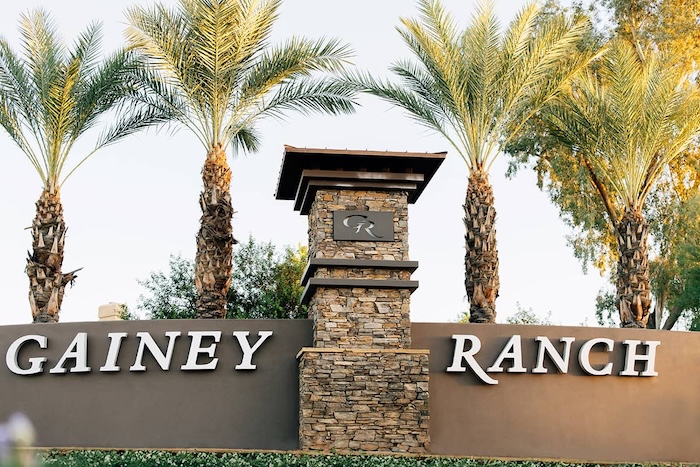
Gainey Ranch is one of Scottsdale’s most iconic communities and much of its identity is rooted in its landscape. Set on a former Arabian horse ranch, the community was master-planned from the start to feel like a living resort, and four decades later, the towering palms, lush green belts, and manicured golf fairways still deliver on that promise.
Mature date palms line the main roads and walking paths, while a curated mix of desert-adapted and tropical species can be found throughout the landscapes of residents.
It’s a neighborhood with a landscape worth taking care of.
Quick Downloads:
Gainey Ranch Plant Health Calendar
Timing guide to fertilization, weed treatment, overseeding, pest control and more.
Tree, & Shrub Watering Guide
Recommendations for when and how much to water, with adjustments for time of year
Tree Identification & Care Guide
Facts about each type of tree in the neighborhood and a guide to keeping them healthy
The current state of Plant Health in Gainey Ranch:
Updated by Cameron, ISA Certified Arborist
February 12th, 2026
The mature, dense landscapes of Gainey Ranch face a unique intersection of challenges heading into 2026. A record-setting climate trend, persistent drought conditions, and several active pest and disease threats are converging in ways that demand attention from homeowners and HOA managers alike. Here’s what we’re seeing and what you should be watching for:
Heat and Drought Stress
The single biggest factor affecting plant health across Gainey Ranch right now is cumulative environmental stress. Phoenix recorded its second-hottest year on record in 2025, with 122 days of triple-digit heat. Winter temperatures have not dropped as low as normal either, meaning trees and shrubs that typically use the cooler months to recover and grow roots are getting less relief than expected. Arizona’s Department of Water Resources continues to issue drought declarations, citing reduced snowpack, lower-than-average river inflows, and persistent long-term drought affecting the state’s water supply outlook through the 2025–2026 water year.
For Gainey Ranch residents, this means even well-irrigated landscapes are under more stress than usual. Trees that appear healthy on the surface may have compromised root systems from years of compounding heat. Drought-stressed trees are significantly more vulnerable to pest infestation and disease, making proper deep watering absolutely critical. February is a key time to ensure irrigation systems are delivering water to the full root zone (24–36 inches deep for mature trees) rather than just wetting the surface.
What to watch for: Premature leaf drop, thinning canopies, branch dieback starting at the tips, and yellowing foliage, particularly on mesquite, palo verde, and ficus trees.
Oleander Leaf Scorch: Still Spreading
If you’ve noticed oleanders in or around Gainey that look drought-burned despite adequate irrigation (leaves browning from the margins inward and entire branches dying off), the likely culprit is oleander leaf scorch (OLS). This fatal bacterial disease, caused by Xylella fastidiosa, was first confirmed in the Phoenix metro area in 2004 and has been spreading steadily through Scottsdale neighborhoods ever since.
The bacterium is transmitted by glassy-winged sharpshooters, which are small flying insects that carry the pathogen from plant to plant as they feed. Once an oleander is infected, the disease is systemic. Pruning off affected branches will not save the plant. Infected oleanders typically decline and die within three to five years. Because oleanders are so widely used as hedge and screen plantings across the neighborhood, particularly along property lines and common areas, an outbreak in one section can move quickly through adjacent plantings.
What to do: There is no cure for OLS. Infected plants should be removed promptly to reduce the reservoir of bacteria available to sharpshooter vectors. If you’re replacing oleanders, consider diversifying with species less susceptible to this disease such as Texas sage (Leucophyllum), Arizona yellow bells (Tecoma stans), or hop bush (Dodonaea viscosa).
Proactive inspection is also a wise strategy, as you can stop the disease before it becomes fatal to oleanders.
Palm Health Concerns: Weevils, Fusarium, and Frond Management
Two threats to palm trees that deserve attention heading into the warmer months:
South American palm weevil (SAPW): This invasive beetle has been devastating Canary Island date palms across Southern California and was first detected in Arizona’s Yuma area in 2015. While established breeding populations have not yet been confirmed in the greater Phoenix area, the pest’s westward spread is being closely monitored by USDA APHIS and University of Arizona researchers. Adult weevils are attracted to wounded or recently pruned palms, where females can lay over 100 eggs. The larvae bore into the crown and feed on the growing tissue, often killing the palm before symptoms are even obvious. Preventive trunk injections with systemic insecticides are currently the most effective protection for high-value date palms.
Fusarium wilt (Fusarium oxysporum f. sp. canariensis): This soil-borne fungal disease is another serious threat to Canary Island date palms. It causes one-sided frond dieback, where fronds on one side of the crown brown and die while the other side appears normal. Critically, the disease is often spread by contaminated pruning tools. Any crew trimming palms in Gainey Ranch should be sterilizing their equipment between each tree.
What to do: Schedule palm trimming with licensed professionals who practice tool sanitation. Avoid over-pruning. Palms need their green fronds for photosynthesis and nutrient storage. Report any palm with a collapsing or tilting crown immediately, as this can indicate advanced weevil infestation or fatal disease.
Ficus Whitefly: A Persistent Problem for Indian Laurel Hedges
Indian laurel ficus (Ficus microcarpa) is one of the most commonly used hedge and shade trees in Gainey Ranch, prized for its dense, glossy canopy. Unfortunately, it’s also the primary host of the ficus whitefly, an invasive pest in the Phoenix area that causes severe defoliation. Infested trees develop yellowing leaves that drop prematurely, often leaving plants nearly bare.
Repeated defoliation weakens trees over time, making them susceptible to secondary infections and potentially killing them if left untreated. Effective management typically involves a single, well-timed soil drench application of a systemic insecticide.
What to watch for: Tiny white insects on the undersides of ficus leaves, sticky honeydew residue on leaves and surfaces below the canopy, and sudden leaf yellowing or drop.
Mesquite and Palo Verde: Borers Love Stressed Trees
Many of the mature mesquite and palo verde specimens throughout Gainey Ranch’s common areas and residential lots are decades old. These native and desert-adapted trees are generally tough, but the compounding effects of recent extreme heat make them increasingly attractive to boring insects.
Flatheaded borers and mesquite borers target stressed trees, laying eggs under the bark where larvae feed on the vital cambium layer, the tissue responsible for transporting water and nutrients. Symptoms include branch dieback, sticky sap oozing from the trunk, and what appears to be sawdust accumulating at the base. Palo verde root borers are large beetles that emerge during monsoon season, attack below the soil line and feed on roots for up to three to four years before damage becomes visible above ground.
The key to preventing borer infestations is maintaining tree health. Proper pest control treatment, deep irrigation on the right schedule, avoiding mechanical damage to trunks from mowers or string trimmers, and resisting the urge to over-prune are your best defenses.
February Action Items for Gainey Ranch Homeowners
- Audit your irrigation system. Check for clogged emitters, misaligned heads, and ensure water is reaching the full root zone of mature trees, not just the surface. Winter irrigation for established desert trees should be deep and infrequent (every two to four weeks), not shallow and frequent.
- Inspect oleanders closely. Look for marginal leaf browning that doesn’t match normal drought patterns. Early identification of OLS allows you to remove infected plants before sharpshooters spread the bacterium to neighboring oleanders.
- Schedule a plant health assessment. Before the spring pruning season, have a plant health care professional evaluate your date palms for signs of Fusarium wilt or pest activity. Preventive trunk injections are most effective when applied proactively.
- Check ficus hedges for whitefly. Flip leaves over and look for tiny white insects or waxy residue. A systemic soil treatment now can prevent the heavy defoliation that typically occurs in the warmer months.
- Take a close look at your trees. Walk your property and examine canopies for thinning, dieback, discoloration, or oozing sap. Trees that look “a little off” after back-to-back record-heat years are telling you something. Early intervention is almost always less costly than removal and replacement.
Need some guidance?
If you have any questions about plant health or your landscape, feel free to give us a call at (602)777-7764 or fill out our contact form.
Anything from a quick question to a free 15-point landscape inspection, we’re here to help.