
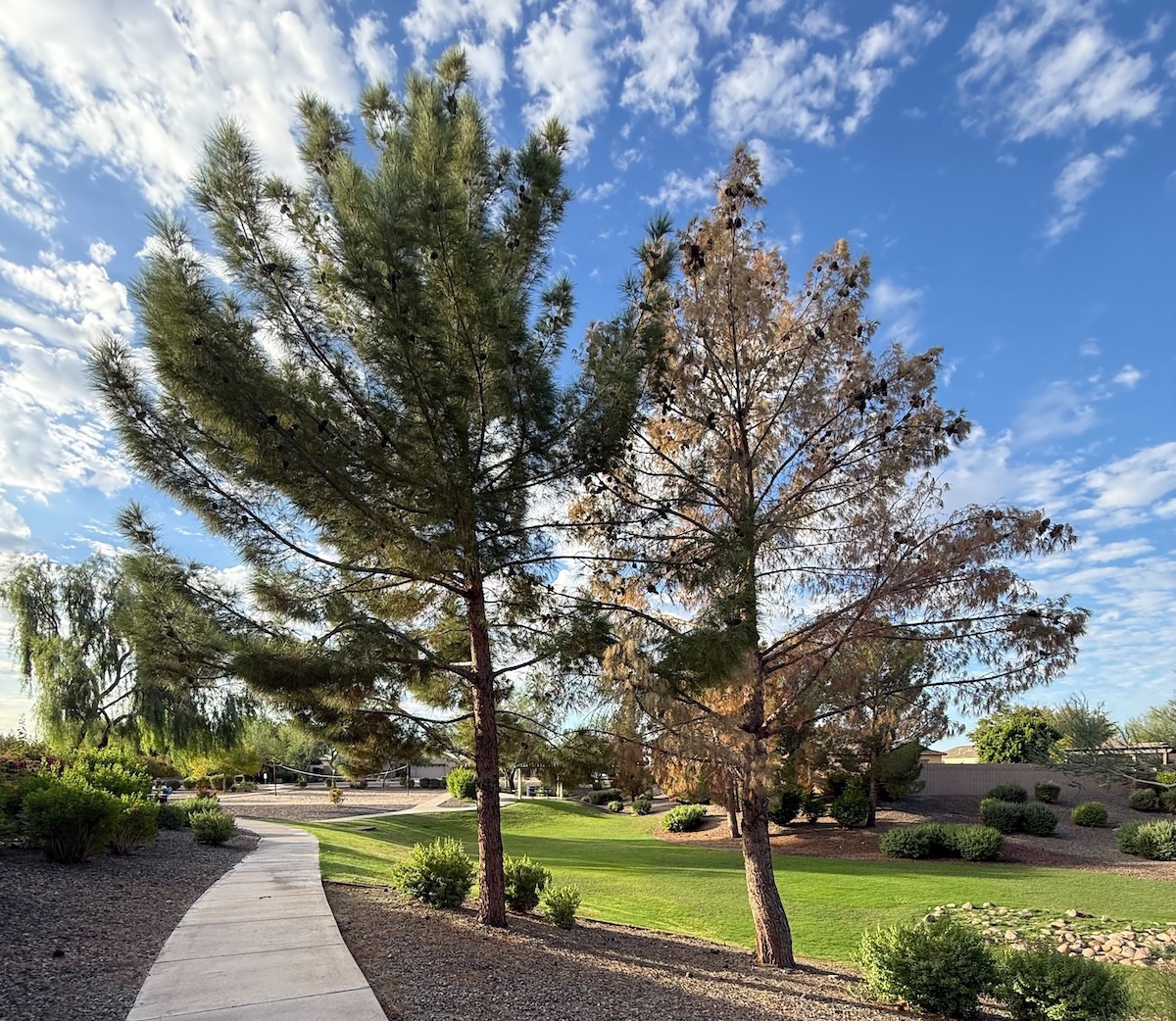
How to Tell If Your Tree Is Dying: 7 Warning Signs Phoenix Homeowners Miss
Phoenix trees face unique challenges. Unlike trees in more temperate climates where abundant moisture and moderate temperatures support steady growth, our desert landscape demands constant adaptation. Trees here battle extreme heat, intense UV exposure, infrequent water, and competition for resources. Sometimes, despite your best efforts, a tree begins to decline. The challenge for Phoenix homeowners is recognizing the warning signs early enough to potentially save the tree through professional intervention, or at least understanding when removal is necessary for safety reasons.
Many homeowners miss critical signals that their trees are in distress. By the time a tree’s decline becomes obvious, it may already be too late to save it. Other times, warning signs that appear serious are actually manageable with proper care. This guide will help you interpret what your tree is telling you and determine whether you’re looking at a temporary problem or a terminal decline.
Why Phoenix Trees Show Decline Differently
Before we dive into the seven warning signs, it’s important to understand why tree health assessment in Phoenix is more complex than in other regions. Phoenix’s intense heat and low humidity create stress conditions that affect how trees respond to problems. A tree in a temperate climate might recover from damage that would be fatal to a tree here. Additionally, Phoenix’s sporadic rainfall patterns mean that trees often experience water stress without obvious external symptoms until the situation is dire.
Phoenix heat stress complicates diagnosis significantly. When temperatures exceed 115°F and persist for weeks, trees experience physiological stress that manifests differently than disease or pest damage would elsewhere. A tree’s response to extreme heat can look similar to its response to root damage, nutrient deficiency, or disease, making it essential to consider Phoenix’s unique environmental factors when evaluating tree health.
Warning Sign #1: Bark Peeling, Cracking, or Sooty Appearance
One of the most visible warning signs of tree distress is unusual bark condition. Healthy tree bark should be relatively smooth and intact, though some species naturally have textured or peeling bark as part of their growth pattern. What you’re looking for are changes from what’s normal for that species.
Bark that’s peeling away to reveal wood underneath can indicate several problems. In some cases, it’s sun scald or heat damage from Phoenix’s extreme temperatures, where the bark literally dies from heat exposure and begins separating from the wood beneath. In other cases, bark peeling indicates damage from animals, weather stress, or cambium death from internal problems.
A sooty, blackened appearance on bark is particularly concerning. This often indicates sooty canker or botryosphaeria canker, two serious fungal diseases that affect many tree species in Arizona. The blackened appearance comes from the fungus itself or from sooty mold that grows on secretions from infected bark. While these diseases can sometimes be managed with proper care and pruning, they also indicate serious stress in the tree. A tree with visible sooty canker is a tree that’s struggling and may not recover.
If you notice significant bark changes, particularly if the bark is peeling away, cracking extensively, or displaying sooty discoloration, it’s time to call a professional ISA Certified Arborist for diagnosis. These symptoms can sometimes be addressed through targeted pruning and care, but they always indicate a tree that needs professional attention.
Warning Sign #2: Leaf Drop Out of Season or Sparse Foliage
Trees in Phoenix should maintain relatively consistent foliage throughout the year, though some deciduous species will naturally drop leaves in fall. Excessive leaf drop out of season or deciduous trees that shed leaves prematurely indicate significant stress.
If your tree is dropping leaves from the bottom up while the upper canopy remains relatively full, this can indicate root stress, poor drainage, or disease moving upward from the roots. If leaf drop is sudden and encompasses the entire tree, you might be looking at water stress, extreme heat damage, or a systemic disease.
What complicates assessment in Phoenix is that some trees naturally thin their canopy during extreme heat as a survival mechanism. They’re shedding leaves to reduce water demand when conditions become desperate. The question is whether the tree will recover by producing new leaves when conditions improve, or whether the leaf loss is permanent.
Persistent sparse foliage, where a tree fails to produce adequate leaves for several seasons in a row, indicates a serious underlying problem. The tree is struggling to generate new growth because something is preventing it. This could be poor roots, disease, extreme stress, or nutrient deficiency. A tree with consistently sparse foliage is not recovering; it’s gradually dying.
Warning Sign #3: Mushrooms, Fungal Growth, or Oozing at the Tree Base
The appearance of mushrooms, fungal fruiting bodies, or unusual oozing around the tree’s base is a significant warning sign. These symptoms typically indicate wood rot from fungal colonization of the tree’s wood tissue.
Mushrooms growing directly on the trunk or at the base are telling you that fungal pathogens have already colonized substantial portions of the wood. The mushroom or fungal fruiting body is just the visible manifestation of extensive internal decay. This internal rot weakens the tree’s structural integrity and indicates that the wood is being consumed from within.
Oozing or weeping from the tree base, particularly if it has a dark or unusual appearance, can indicate bacterial wetwood or similar infections. The tree is essentially bleeding from internal infection. This is a serious sign that shouldn’t be ignored.
In some cases, when detected early, fungal infections can be slowed or halted through strategic pruning, improved care, and in some instances, targeted fungicide applications. However, once mushrooms are visibly fruiting or extensive internal rot has occurred, the tree’s structural integrity is compromised, and it becomes a safety liability. A certified arborist can assess how far the decay has progressed and whether the tree can be saved.
Warning Sign #4: Branch Dieback Starting from the Tips
Gradual dieback that progresses from the branch tips inward and then moves from lower branches upward is a classic sign of tree decline. Healthy trees maintain living tissue throughout their canopy. When you see branches dying back from the tips, the tree is essentially giving up on those growth points and pulling resources inward.
Branch dieback can result from multiple causes: root problems that prevent adequate water and nutrient uptake, disease moving through the vascular system, insect damage that’s girdled branches, or extreme stress conditions. The location of the dieback provides clues. Dieback on one side of the tree might indicate a root problem on that side, or damage to the vascular system on that side of the trunk. Uniform dieback around the entire tree typically indicates a more systemic problem affecting the whole tree.
The progression of dieback is important for assessment. Slow, gradual dieback over years might be a tree that’s aging or responding to chronic stress, but it’s still alive and might have years of useful life remaining. Rapid dieback that progresses significantly within weeks or a couple of months is more alarming and suggests a serious, acute problem like disease or severe stress.
If you’re seeing branch dieback in your tree, resist the urge to wait and see. Call a professional arborist to diagnose what’s causing it and what options exist for treatment or management.
Warning Sign #5: Leaning, Root Heaving, or Visible Structural Problems
A tree that’s leaning significantly or showing signs of unstable roots is a tree with potential to become a hazard. In Phoenix’s rocky soil and with our water patterns, root systems sometimes fail or become unstable, particularly as trees age or after extreme weather events.
You might notice the tree itself is leaning at an unusual angle, or you might see roots heaving up from the ground surface, creating bumps or exposed wood. You might see cracks in the soil around the tree base indicating root heaving, or the tree might have visibly shifted position compared to nearby structures.
While some leaning is normal for mature trees, and some root systems naturally work their way to the surface, significant structural problems usually indicate that the tree’s foundation is compromised. A leaning tree becomes increasingly unstable as it continues to grow, and the lean often worsens over time. Root heaving indicates that the root system is no longer effectively anchored.
These are safety issues first and foremost. A structurally compromised tree is at increased risk of failure, particularly during Phoenix’s monsoon wind events. Whether the tree can be saved through support systems, pruning, or cabling depends on the specifics of the situation, but this is definitely a situation requiring professional assessment before any decisions are made.
Warning Sign #6: Bark Beetle Bore Holes or Small Openings in the Trunk
Bark beetle damage appears as small, pinhole-like openings in the bark, often with tiny mounds of sawdust or frass around the holes. These holes represent entry points and tunneling by bark beetles, which are attracted to stressed trees.
Here’s the critical point about bark beetles: they’re not the primary problem. Bark beetles don’t typically attack healthy, vigorous trees. The fact that bark beetles are colonizing your tree is a sign that the tree is already stressed and weakened. The beetles are taking advantage of a tree that’s already struggling. Their boring can further damage the tree and accelerate decline, but the underlying stress condition is the real issue.
If you see bark beetle damage, your tree is experiencing significant stress from something else like root problems, water stress, disease, or other factors. The beetles are a symptom that things have already gotten bad. This is a situation that warrants professional diagnosis to understand what stress condition attracted the beetles in the first place.
Warning Sign #7: Canopy Thinning Over Multiple Seasons
Perhaps the subtlest and yet most indicative warning sign of tree decline is gradual canopy thinning that persists over multiple growing seasons. A healthy tree maintains a full, dense canopy. As it ages, the canopy might naturally thin somewhat, but the tree should still produce abundant foliage.
When you notice that your tree’s canopy is noticeably thinner than it was two years ago, and it’s not recovering, that’s your tree telling you it’s struggling. The thinning canopy indicates that the tree is producing fewer leaves than it’s losing, and it’s not maintaining adequate foliage. This progressive thinning is often accompanied by a feeling of “the tree just doesn’t look as healthy as it used to.”
Canopy thinning often occurs when root systems are slowly failing, when a tree is in the early stages of disease, or when stress conditions are gradually accumulating. The tree hasn’t suddenly died; it’s slowly declining. But the progressive nature of the decline is actually important information. If the situation doesn’t improve, the decline will continue until the tree becomes a hazard or dies entirely.
Progressive canopy thinning is your opportunity to intervene. This is arguably the best stage to have a professional assessment and explore whether the tree can be saved or whether plans need to be made for removal.
Is Your Tree Treatable or Terminal?
Recognizing warning signs is only half the battle. You also need to understand whether a tree showing these symptoms is still treatable or whether you’re looking at a terminal decline. Several factors determine this.
Age and History: How old is the tree? An older tree that’s declining might be naturally reaching the end of its lifespan, whereas a younger tree with the same symptoms might be responding to a fixable problem.
Extent of Damage: Is the damage localized to part of the tree or affecting the entire tree? Localized problems might be treatable through targeted pruning. Systemic problems affecting the whole tree are harder to address.
Tree Vigor: Is the tree producing any new growth, new shoots, or new leaves? A tree that’s completely dormant and producing no new growth is worse off than a tree that’s showing signs of stress but still attempting to grow.
Specific Diagnosis: What’s actually causing the problem? Some conditions are treatable; others are not. A tree with a fixable water problem is different from a tree with a vascular disease that can’t be cured.
Safety Considerations: Regardless of whether a tree might theoretically be savable, if it’s become a structural hazard that poses risk to property or people, removal might be the necessary choice.
This is why professional assessment is so valuable. An ISA Certified Arborist can often determine whether a tree is in terminal decline or whether there’s potential for recovery and what interventions might help.
When to Call a Professional Arborist
You should contact a professional arborist if you notice any of these warning signs, but certain situations warrant immediate action. Contact Adaptive Plant Health & Weed Solutions immediately if you see:
- Multiple warning signs present at the same time
- Significant structural problems or dangerous leaning
- Branch dieback progressing rapidly
- Mushrooms or fungal growth indicating internal rot
- A tree that’s obviously changed dramatically in appearance over a short period
A professional ISA Certified Arborist can assess your tree, determine what’s causing the problems, explain whether the tree is savable, and outline your options. Sometimes that means a care plan to improve the tree’s health. Sometimes it means cabling or structural support. And sometimes it means planning for removal and replanting.
Frequently Asked Questions About Tree Decline in Phoenix
Can a tree recover if it’s showing multiple warning signs?
It depends on what’s causing the symptoms and how advanced the problems are. Some trees can recover if the underlying problem is addressed. For instance, a tree with stress from improper watering can bounce back if irrigation is corrected. However, a tree showing multiple advanced symptoms of decline is unlikely to recover. A professional assessment can clarify the specific situation.
If my tree is dying, how quickly does it happen?
Tree decline can be rapid or extremely slow depending on the cause. Some diseases or severe stress can cause visible decline within weeks. Other conditions cause gradual decline over years. Most homeowners don’t notice problems until significant decline has already occurred.
Is it better to remove a dying tree immediately or wait and see?
Waiting generally isn’t advisable once a tree is clearly in decline. As the tree deteriorates, it becomes increasingly unstable and poses greater safety risks. Additionally, the longer a declining tree remains, the more resources it consumes that could go toward a healthier landscape. Have a professional assess the situation and help you make an informed decision.
Can I save a tree by adding more water or fertilizer?
Adding water or fertilizer without knowing what the actual problem is can sometimes help, but it can also make things worse. If the problem is root rot, adding water exacerbates it. If it’s pest or disease damage, fertilizer won’t solve the underlying issue. Diagnosis before treatment is important.
What’s the difference between a tree that looks bad and a tree that’s actually dying?
A tree that looks bad might be experiencing temporary stress like drought stress during extremely hot summers. But if the tree produces new growth when conditions improve and returns to normal appearance, it was stressed but not dying. A truly dying tree fails to recover and shows progressive decline even when conditions improve.
Should I cut down a dying tree myself?
Tree removal, especially for large trees, should be handled by professionals. Improper removal can damage property, injure people, or create safety hazards. Professional arborists have proper equipment and insurance to remove trees safely.
Can trees in Phoenix be treated for diseases like sooty canker?
Some fungal diseases can be managed through pruning infected branches, improving tree health through proper care, and in certain cases, targeted fungicide applications. However, once advanced infection has occurred, curing the disease might not be possible. Early intervention and prevention are more effective than treatment of advanced disease.
By the Adaptive PHS Team | ISA Certified Arborists & Plant Health Experts
If you’ve noticed warning signs in any of your Phoenix trees, don’t wait. Contact Adaptive Plant Health & Weed Solutions for a professional arborist assessment. Our ISA Certified Arborists can diagnose problems, explain your options, and help you make the best decision for your landscape.
Related Resources: